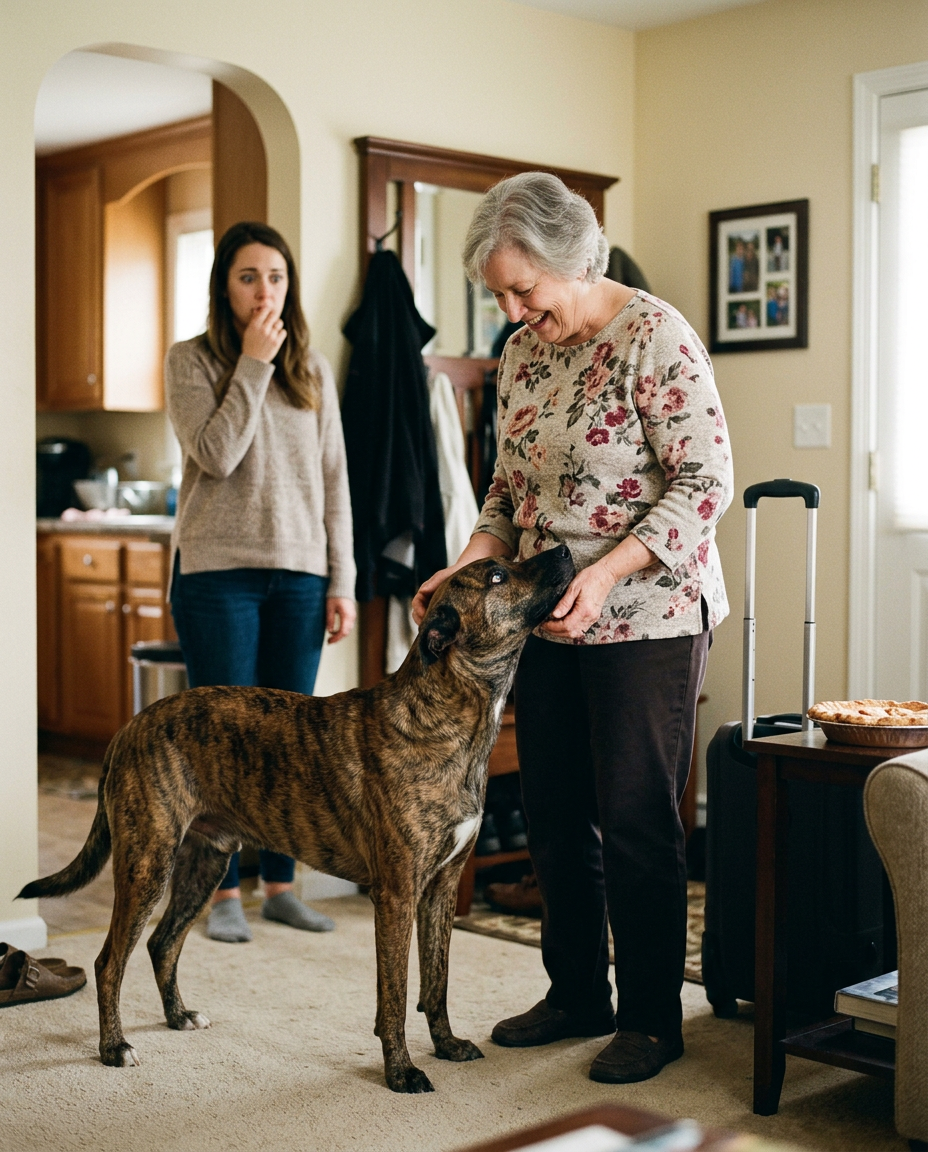
She didn’t bark. She never barked.
That was the thing about Rue — the six-year-old brindle mutt that Cassandra had adopted from the county shelter three years ago. Rue was quiet in a way most dogs weren’t. She didn’t beg at the dinner table, didn’t chase the neighbor’s cat, didn’t lose her mind when the mail truck pulled up. She was calm, deliberate, almost watchful.
Which is why, when Rue started sitting in front of the basement door every single morning, Cassandra noticed.
Not scratching at it. Not whining. Just sitting. Perfectly still, nose lifted, eyes fixed on the seam where the door met the frame. Like she was reading something printed in a language no one else in the house could see.
Cassandra mentioned it to her husband, Derek.
“She probably heard a mouse,” he said, not looking up from his phone. “Call an exterminator if it bothers you.”
It wasn’t mice. Cassandra knew that somehow, the way you know things in the soft, unspeakable language of living with an animal. She started watching Rue more closely. The dog would press her nose to the door’s edge, hold it there for a long moment, then look back at Cassandra with an expression she could only describe as deliberate.
You’re not seeing this. I need you to see this.
Three weeks after Rue’s vigil began, Cassandra’s mother came to stay for a long weekend. Vera was sixty-four, sharp as a pin, and had never once admitted to feeling unwell in all the years Cassandra had known her. She arrived with her rolling suitcase and a peach cobbler and a comment about Cassandra’s hair.
But Rue did something she had never done before.
The moment Vera walked through the front door, the dog abandoned her post by the basement and crossed the living room in a straight line. She pressed her nose — not to the basement door, not to the baseboards — but to Vera’s left side. Just below her ribs. She stayed there for nearly ten seconds, unmoving, inhaling.
Vera laughed it off. “Goodness, she can probably smell the cobbler.”
Cassandra didn’t laugh. She stood in the doorway of the kitchen and watched her dog and felt something cold move through her chest.
She made the call the next morning while her mother was still asleep.
Her mother’s doctor, the one Vera had been seeing for a decade, listened carefully when Cassandra explained what the dog had done. There was a pause on the line — the kind of pause that means someone is deciding how seriously to take you.
“Bring her in Monday,” the doctor said quietly. “There are some things we’ve been wanting to recheck.”
The scan found it. A growth, just below the left rib line, that the routine physical the year before had missed. Caught early. Treatable.
When Cassandra hung up the phone, she sat down on the kitchen floor. Rue padded over and rested her chin on Cassandra’s knee and didn’t move.
“How did you know?” Cassandra whispered. “How long have you known?”
Rue looked up at her with those dark, steady eyes.
She had been trying to tell them for weeks. Not about the basement — that turned out to be a slow gas leak from an aging water heater. About Vera. About the invisible thing growing where no eye could see it.
The exterminator found the heater issue three days later. He called it a “lucky catch.” Cassandra nodded and thanked him and didn’t say anything about the dog who had been standing guard at that door every morning for a month.
Vera completed her treatment eight months later. On the last day of her final follow-up appointment, she called Cassandra from the parking lot of the medical center, her voice high and slightly undone.
“They said I’m clear, Cass.” A pause. “How is Rue?”
“She’s good,” Cassandra said. “She’s asleep on the couch.”
“Tell her—” Vera stopped. Started again. “Tell her I said thank you.”
Cassandra looked over at the dog, sprawled across the cushions in a patch of afternoon light, chest rising and falling in the deep, uncomplicated rhythm of a creature at peace with the world.
She didn’t need to be told. She already knew.