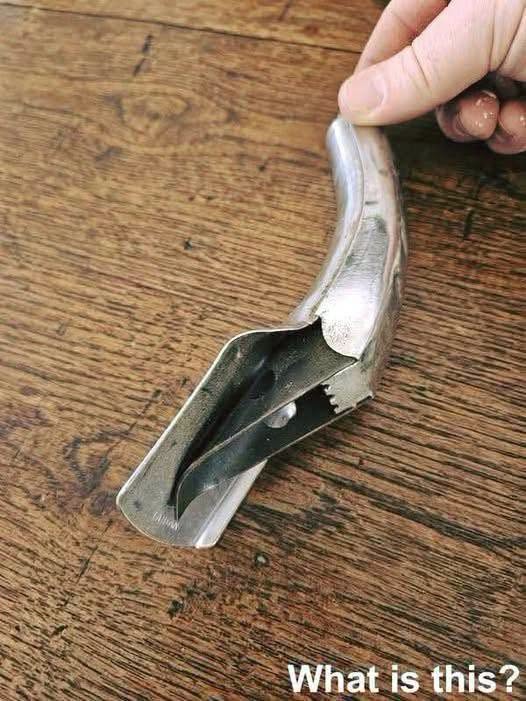
This Rusty Object Had No Name. Then Collectors Cracked the Code.
It looks like nothing you’ve ever held. No brand. No instructions. Just a strange shape and a weight that feels deliberate, like someone built it for a job that no longer exists.
Across the country, people are finding objects like this in inherited toolboxes, estate sales, and barn cleanouts. Most have no idea what they’re holding. A growing community of collectors says that’s exactly the point — and that almost every one of these objects can be identified.
The Detective Work Hiding in Plain Sight
Tool collectors don’t start with guesswork. They start with a method.
According to identification guides used by collectors, the first step is asking what the object physically does. Does it cut, hold, strike, or pierce something? Cutting tools have teeth or a sharp edge. Holding tools clamp things together. Striking tools have a flat surface built to hit something else. LoveToKnow
Material matters next. Fine materials like ivory or tortoiseshell usually point to light, decorative use, while iron, steel, or heavy wood suggest a purely utilitarian purpose. LoveToKnow
Then comes age. Collectors define an antique as at least 100 years old and a vintage tool as at least 20 years old, judging that mainly by patina, wear, and the kind of materials used. Stainless steel and plastic point to the 20th century, while worn wood and cast iron suggest something older. LoveToKnowLoveToKnow
A Trail of Clues Left by the Manufacturer
Sometimes the tool itself tells you when it was born.
Experts say tool materials shifted in identifiable waves — hand-forged wrought iron before 1800, a move to cast iron bodies with steel edges through the mid-1800s, and the arrival of more consistent alloy steels by the early 1900s. A single shift in metal can place a mystery object within a few decades. Appraisily
But there’s a trap collectors warn beginners about constantly: the patent date.
A patent stamp only proves when a design was legally protected — not when that specific tool was made. Manufacturers often kept using the same stamped date for years, sometimes decades, after the original patent was filed. A tool stamped 1884 could easily have been built in 1910. WhatIsThisTool
Finding the stamp at all takes technique. Worn manufacturer marks show up far better in raking light — holding the tool at an angle to a lamp or window — than under direct overhead lighting. WhatIsThisTool
When the Trail Runs Cold, the Community Takes Over
Some tools resist every clue. No stamp, no obvious use, no match in any catalog.
That’s when collectors turn to each other. Photos posted to the Oldtools mailing list or the r/vintagetoolcollecting subreddit typically get identified within hours, according to longtime collectors — proof that even genuinely obscure tools usually have someone, somewhere, who recognizes them on sight. WhatIsThisTool
Behind that speed is an institution most people have never heard of. The Early American Industries Association was founded in 1933 by people worried about vanishing trades and the tools tied to them — a concern that pushed them to document obsolete tools before the knowledge disappeared entirely. Members eventually built the Directory of American Toolmakers, a reference now containing more than 14,000 makers’ names dating back to 1636 — a resource collectors still consult to trace a stamped name to an actual person and workshop. WikipediaAmazon
What We Know
Identification methodology starts with three questions: what does the tool physically do, what is it made of, and how was it built
“Antique” generally means 100+ years old; “vintage” means 20+ years old, judged by patina, material, and construction LoveToKnow
Tool materials shifted in traceable phases — wrought iron, then cast iron with steel edges, then alloy steel — helping narrow down manufacture era Appraisily
Patent stamps mark a minimum possible age, not the actual manufacture date WhatIsThisTool
The Early American Industries Association, founded in 1933, remains a leading nonprofit resource for tracing obsolete American tools and trades Wikipedia
Online collector communities can often identify an unmarked mystery tool within hours of a photo being posted WhatIsThisTool
Why This Matters
Every unmarked tool sitting in a garage or inherited toolbox is a small thread connecting a family to a trade, a decade, and a person who once relied on it to make a living. In a country where manufacturing jobs and hands-on trades have steadily declined for generations, these objects are some of the last physical evidence that those skills — and the people who had them — ever existed at all.
That’s also why losing the ability to identify them isn’t just a hobbyist’s problem. Once a tool’s purpose is forgotten, the trade behind it effectively disappears a second time.
A mystery object isn’t really mysterious. It’s a question waiting for someone who still remembers the answer.