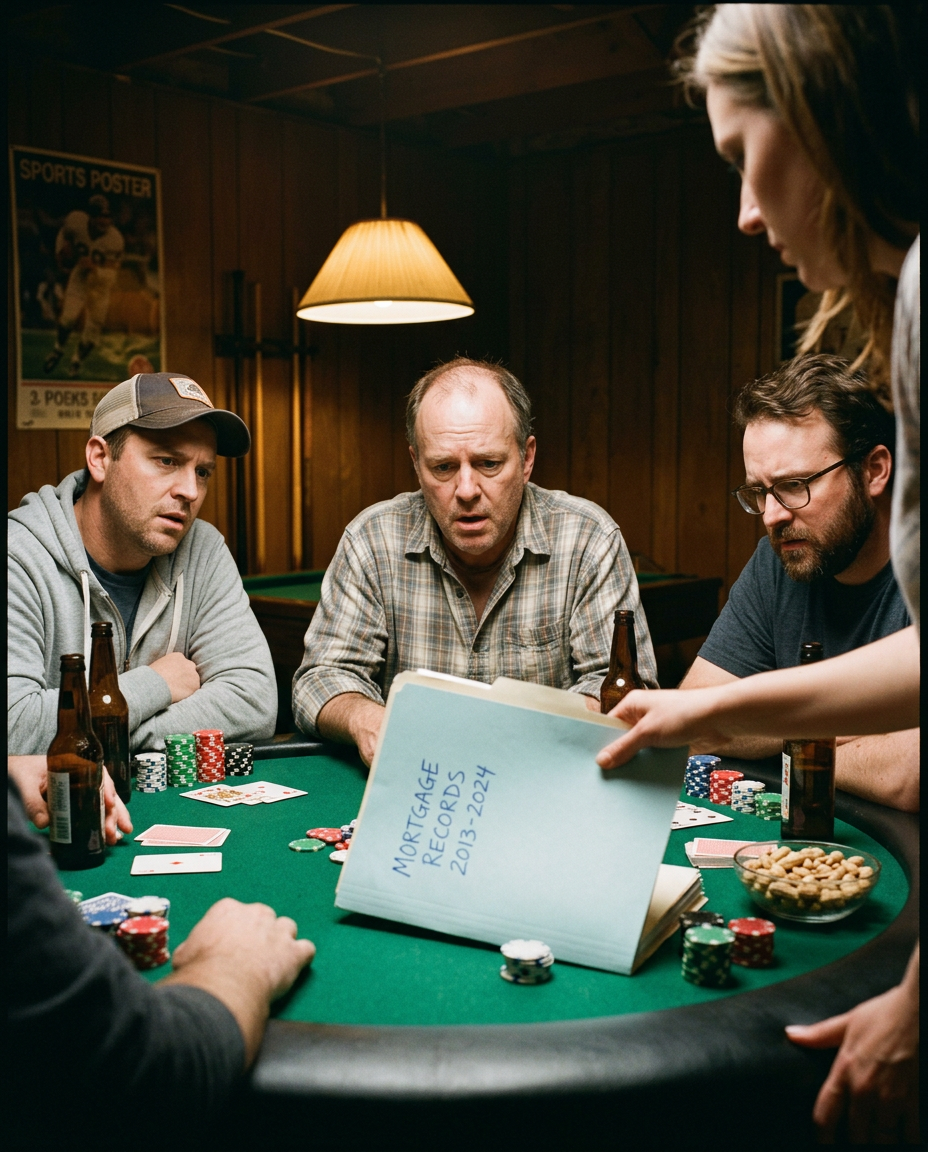
Some humiliations are quiet. Mine happened in front of five men, a bag of pretzels, and a card table my husband refused to let me sit at.
My name’s Carol, and I’d been married to Russ for eleven years when I finally understood what he thought of me.
We lived in a small ranch house at the edge of town, the kind with a carport and a mailbox shaped like a barn. Russ worked at the hardware store his father used to run, and once a month he hosted poker night for the men from the volunteer fire department. I usually made the chili, set out the folding chairs, and disappeared upstairs before the first hand was dealt. That was the arrangement. I never minded it — not until that October.
The night the jukebox at Palmer’s Diner got replaced with a new one, Russ came home bragging about it like he’d built it himself. He’d stopped there on the way home, told the guys at the counter he’d “earned a treat” after “carrying the whole family on his back all week.” I said nothing. I’d been the one running the diner’s books since spring, unpaid overtime he didn’t know about because he never asked what I did with my afternoons.
That poker night, I came downstairs for water and found the men laughing at something. Russ waved a hand toward me without even turning his head.
“That’s just Carol. She keeps the place tidy. Doesn’t do much else.”
Nobody defended me. One man, Walt, looked embarrassed and quickly went back to his cards. I filled my glass and walked back upstairs, and something in me went very still.
The turning point came the following morning, when Russ asked me — casually, over burnt toast — to run to the bank and “get some cash out for the game next month.” I looked at him for a long moment. Then I asked him whose name was actually on the account.
He blinked. “What kind of question is that?”
“An honest one,” I said. “Because I don’t think you’ve looked at a bank statement in three years.”
I drove to the bank that morning, but not for cash. I asked the teller to print the full ownership history on our house and our two accounts. Every signature. Every deposit. When Russ’s father passed, I was the one who’d handled the estate, because Russ couldn’t stomach paperwork. The house had gone into both our names — but the mortgage payments, every single one, had come from my account, the one funded by the diner job and the tax preparation I did on the side every spring. Russ had never asked where the money came from. He’d just assumed the bills paid themselves.
That night, when he hosted poker again — this time to celebrate a small raise — I set a folder on the card table between the pretzels and the beer.
“Since I’m the one who keeps things tidy,” I said, “I thought I’d tidy this up too.”
Walt was the first to open it. He went quiet, then looked up at Russ. “You said you paid off the house.”
Russ’s face changed color. “Carol, this isn’t the time—”
“You’ve had eleven years of times,” I said. “I picked tonight.”
I laid out the tax filings. The insurance payments. The receipts from the tax season I’d built our savings account back up almost single-handedly after his shop had a bad year. Nobody at that table said a word. The radio in the kitchen kept playing, tinny and oblivious, while five grown men looked at my husband like they were seeing him for the first time.
“I never needed you to brag about me,” I told him quietly, once the men had gathered their coats and made their apologetic goodbyes. “I needed you to just tell the truth.”
Russ didn’t sleep on the couch that night — he packed a bag and stayed at his brother’s for a week. When he came back, something between us had shifted permanently. We didn’t divorce. But I stopped disappearing upstairs on poker nights. I started dealing the hands myself.
I still don’t know if he ever fully understood what he’d lost that October. But I know what I found: I wasn’t the woman who kept things tidy. I was the reason there was anything worth keeping at all.