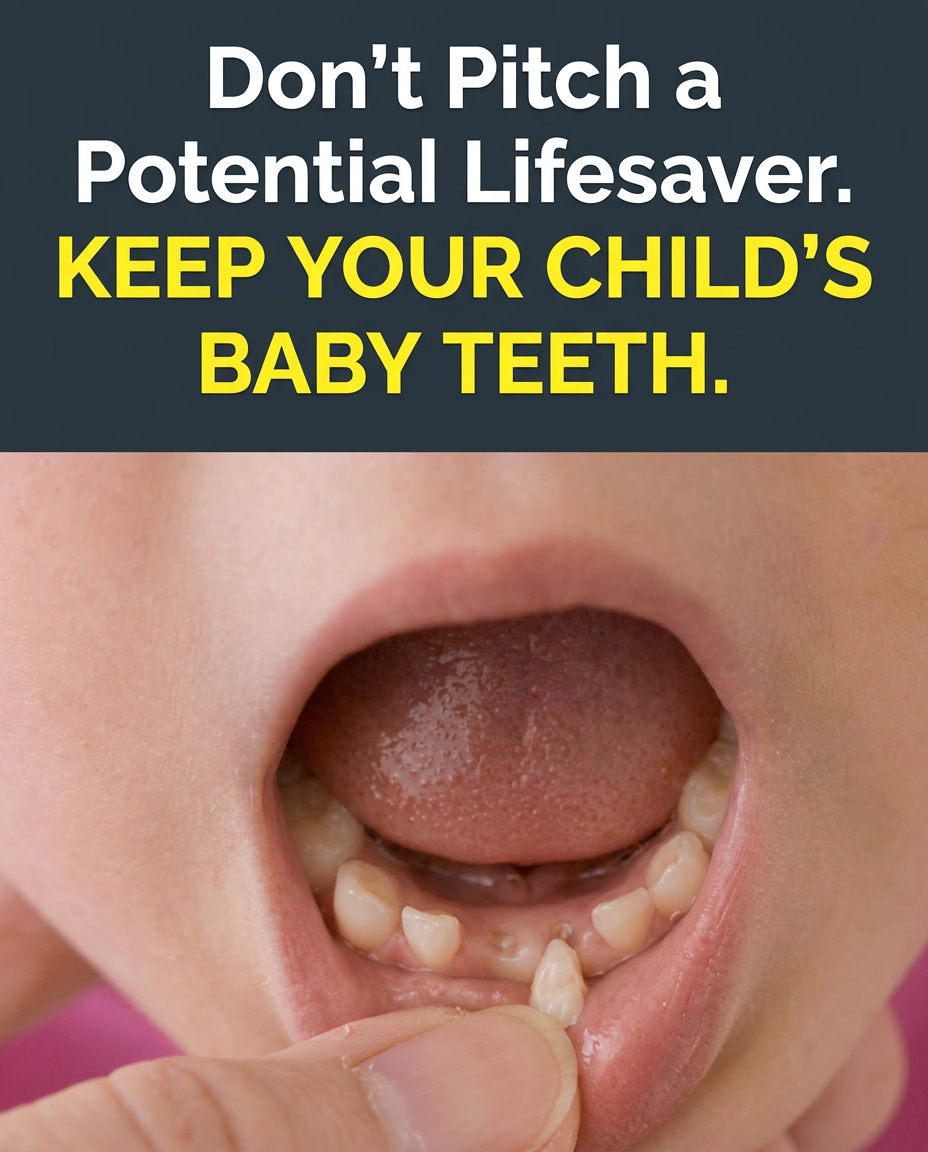
Before You Throw Away Your Child’s Next Lost Tooth, Read This
The little ritual is familiar to almost every parent: a baby tooth falls out, goes under the pillow, and disappears by morning. But scientists say what gets tossed in the trash may deserve a second look — and a growing industry has built a business around that idea.
Researchers have confirmed that the soft pulp inside baby teeth contains live stem cells — the body’s biological building blocks — capable of developing into bone, nerve tissue, cartilage, and potentially more. The science is real. What parents do with that information, though, is where it gets complicated.
What’s Actually Inside a Baby Tooth
Stem cells have been found in the pulp of baby teeth — called “deciduous” teeth — which children naturally shed during the first six to twelve years of development. These aren’t just any cells. Research has shown that dental pulp stem cells proliferate rapidly, share gene expression profiles similar to bone marrow stem cells, and can differentiate into multiple tissue types including bone and fat cells. PubMed CentralScienceDirect
The promise driving this field spans conditions as diverse as cancer, autism, neural degeneration, and organ replacement. Pre-clinical results have been striking. A 2024 review found that dental pulp-derived cells may help clear amyloid plaques and reduce brain inflammation — findings relevant to Alzheimer’s research. Researchers have also observed improvements in heart function in animal models, and orthopedic scientists see potential in cartilage repair. ResearchGateEarth.com
But here’s the part most tooth-banking companies don’t lead with: none of these therapies are available to patients yet.
A Growing Industry — and a Growing Debate
Dental stem cell preservation services — commonly called “tooth banks” — focus on collecting baby teeth as they shed naturally and storing the stem cells in the pulp for potential therapeutic use years later. After processing, stem cells are frozen under liquid nitrogen until potentially needed, at which point they can be thawed and expanded to a therapeutically appropriate number before being returned to the donor. ScienceDirectPubMed Central
Because the cells come from the child’s own body, there is no risk of immune rejection — a significant theoretical advantage over donor-based treatments.
But UC Davis cell biologist Professor Paul Knoepfler, one of the field’s most cited independent researchers, urges parents to read the fine print. What is banked by many firms is likely a heterogeneous cell mix that is mostly not true stem cells, since most companies do not perform the specialized cell isolation needed to confirm stem cell identity. He notes the American Academy of Pediatric Dentistry recognizes the theoretical potential of dental cell banking — but stops short of recommending it. The Niche
The Cord Blood Story Parents Are Sharing — and Why It’s Being Misread
The viral hook circulating on social media involves a boy named Jenson Wright, who was diagnosed with leukemia at age seven after a prior cancer diagnosis at age four. Two rounds of chemotherapy had failed. His mother, Carolyn, wrote on Facebook that doctors feared “every parent’s nightmare.”
What saved Jenson was a stem cell transplant — but not from a baby tooth. A mother in Texas had donated her newborn’s umbilical cord blood to a public bank. That stored cord blood gave Jenson the healthy stem cells his body needed to fight the cancer. By 2019, his doctors declared him cured.
It’s a powerful story. It also has nothing to do with dental stem cell banking. Umbilical cord blood is already used in FDA-approved treatments. Baby tooth banking is not. Conflating the two — as some viral posts have — misrepresents where the science actually stands.
What We Know
Baby teeth contain live stem cells in the dental pulp, confirmed by peer-reviewed research
These cells have shown promise in pre-clinical studies for conditions including Alzheimer’s, Parkinson’s, heart disease, and bone repair
No FDA-approved treatments currently use banked baby tooth stem cells
Private tooth banks charge collection and ongoing storage fees; costs vary by provider
The American Academy of Pediatric Dentistry acknowledges theoretical potential but has not endorsed tooth banking
Umbilical cord blood — a separate technology — is already used in approved treatments for certain blood cancers and disorders
Why This Matters
American families spend billions each year on health insurance, supplements, and precautionary medical decisions. The dental stem cell banking industry is marketing directly to that instinct — the deep parental drive to protect a child from the worst. That’s not inherently wrong. But researchers say it is too soon for commercialization, and that some firms are making claims that go well beyond what the current science supports. The Niche
The underlying biology is genuinely exciting. As of mid-2025, 23 registered clinical trials involving dental stem cells have been identified on ClinicalTrials.gov, with 14 meeting inclusion criteria for serious review — a sign the field is moving toward legitimate human study. But moving toward is not the same as arriving. ScienceDirect
For now, the most honest thing a parent can know is this: your child’s lost tooth may one day matter more than you thought. Whether paying to store it today is the right choice depends on science that hasn’t finished writing its own story.