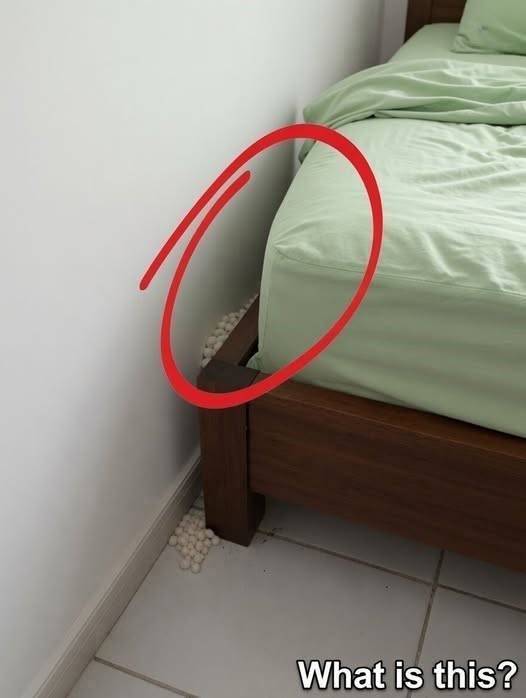
The scene is every homeowner’s nightmare: You climb into bed after a draining day, only to discover a cluster of mysterious white spheres tucked into the shadows near your pillow. For one individual, this unsettling find triggered immediate panic, leading to a desperate search for answers.
While social media is often quick to label any unexpected household discovery as a pest infestation, the reality of what might be lurking in the crevices of your bedroom is often less exotic—and more mundane—than you might imagine.
The Search for Truth
When unidentified objects appear in the home, experts emphasize looking past initial reactions of fear. While the instinct might be to assume the worst, biological evidence rarely aligns with the “cluster” look often seen in viral images.
According to wildlife experts, true house gecko eggs are not typically laid in massive, perfectly uniform piles. These eggs usually feature a hard, chalky, or leathery shell and are often deposited singly or in pairs, frequently attached to surfaces rather than scattered loosely. The sheer uniformity seen in many of these viral instances often suggests a synthetic origin, such as internal cushioning material from a mattress or a shredded beanbag chair, rather than a biological nest.
What We Know
The Discovery: A cluster of small, white, spherical objects was found in a domestic sleeping area.
The Biological Reality: Most house lizards do not lay large, marble-like clusters; they prefer secure, humid, and dark crevices for single or paired eggs.
The Likely Suspect: Synthetic materials, such as polystyrene foam beads common in modern furniture, are frequently mistaken for eggs when they leak from damaged upholstery.
Identification Tips: Genuine eggs will have varying shapes, leathery textures, and lack the manufactured precision of plastic beads.
Why This Matters
For millions of Americans, the home is a sanctuary, and the sudden realization that it may have been compromised—whether by pests or a structural failure of furniture—triggers a deep sense of vulnerability. It’s not just about the objects themselves; it’s about the loss of control in one’s own private space.
This incident serves as a reminder to conduct a “safety audit” of your living environment. Before assuming a pest invasion is underway, take a closer look at the integrity of your furniture. If you find strange debris, check for tears in mattress seams, cushions, or hidden insulation.
If you are ever in doubt, rather than panicking, collect a sample in a sealed container and consult a local pest control professional or an extension office. They can provide an objective, expert identification that clears the air—and gives you back your peace of mind.
“When you find something out of place, the best defense is curiosity, not fear,” one industry expert noted. Often, the answer is sitting right in the fabric of your home.